Skåne Architecture Guide
August 27th, 2021Skåne [South of Sweden Region] Architecture Guide
This map traces both places I visited (red-drop) and places I wish to visit (yellow-drop). It is arranged by city and has a collective large Skåne Extended Area (collecting all the South of Sweden)
There is no special time span and buildings could be contemporary, modern, ancient, etc.: I am the only person responsible for the selection that actually follows my interests and my sensibility without any historiographical criteria. Despite the fact It is a totally subjective work, the collection contains knowledge about architecture embodied in architecture artefacts: it is about “built thoughts”. Each reader can eventually decide what to look at and what s/he is able to learn from it.
When you find a red-drop, it means I uploaded details about the work (mainly pictures shot by me and eventually, if of interest, some external links). At a later stage, I hope to collect also some drawings to add in each picture folder.
Last but not least, when you find a violet-drop, it means I consider the work a masterpiece.
Tips for smart working teaching*
January 18th, 2021* Tips received – and very well accepted – by an International colleague teaching in Scandinavia.
7 things to think about to improve your work from home situation
By now most of us are back to work – but probably not “at work” – after the holidays. Here are seven points to check to make the most of your work from home situation.
Under the current circumstances, more and more people are forced to try working from home – and will soon discover that it may not be as comfortable as it sounds. In addition to the home’s ergonomic shortcomings, there are also other difficulties, such as finding focus and a boundary between work and leisure. But everything works and here are seven tips on how to work efficiently even at home.
1. Select a dedicated workspace
The first priority is to allocate a special area so that the workplace is kept separate from the rest of the home. Partly to avoid cleaning up after each work shift, partly to get “a job to go to” – a mental space that makes it easier to separate the job from free time. It is best to have a separate room that you can close and only use to work in. If you have no room left over, you can choose another delimited area, for example the area under the stairs.
2. Make sure you sit comfortably
The kitchen chair is not an option in the long run, you need the comfort and functionality of a real office chair Since you are likely to sit and work for several hours every day, and incorrect sitting causes many problems, it is important to have a chair that follows your body’s movements and helps you to sit right.
3. Get a good desk
One of the benefits of having a special work table is that you can leave things behind after the end of the work day. And there are desks in many different formats and designs to choose from. A height-adjustable desk costs a little more, but pays off quickly. Being able to change position during long working days is nice for the body, and you also become both more productive and creative when standing!
4. Upgrade the technology
To be able to work efficiently, the home office’s technical capacity should preferably be on a par with your regular workplace. Think about what features your computer and phone should have and choose professional versions of the software packages. Also make sure to upgrade your internet connection if necessary.
5. Review the lighting
Good lighting makes a big difference to the work effort. Natural light is always best, so try to place your desk as close to a window as possible. Your workplace should also have adequate ceiling lighting so that you do not have to rely on daylight. A table lamp makes it easy to work even during the evening shift. In order not to strain the eyes unnecessarily, the light should not shine directly on the computer screen.
6. Structure your day
Try to have structure in the working day even when you work from home. Get up at the same time as usual. Feel free to take a short walk before work, then you get fresh air while you mentally adjust to “going to work”. Keep to your routines, have lunch as usual and end the day at the usual time. Finish by writing a checklist of what to do the next day. Then you have all the prerequisites to succeed.
7. Spend time with colleagues
Perhaps the biggest difference initially is that you are not surrounded by happy colleagues. It may feel boring, but working from home does not have to mean an end to your social contacts. You and your colleagues can, for example, try to take coffee breaks together via Facetime or Skype. But since everyone can have their unique needs – try not to “disturb” each other during the lunch break.
Covid-19_EU_201024
October 25th, 2020Italia, indice di mortalità 7,38%
Prima in Europa!
Riflettiamo.
Transatlantic Transfer Roundtable
September 29th, 2020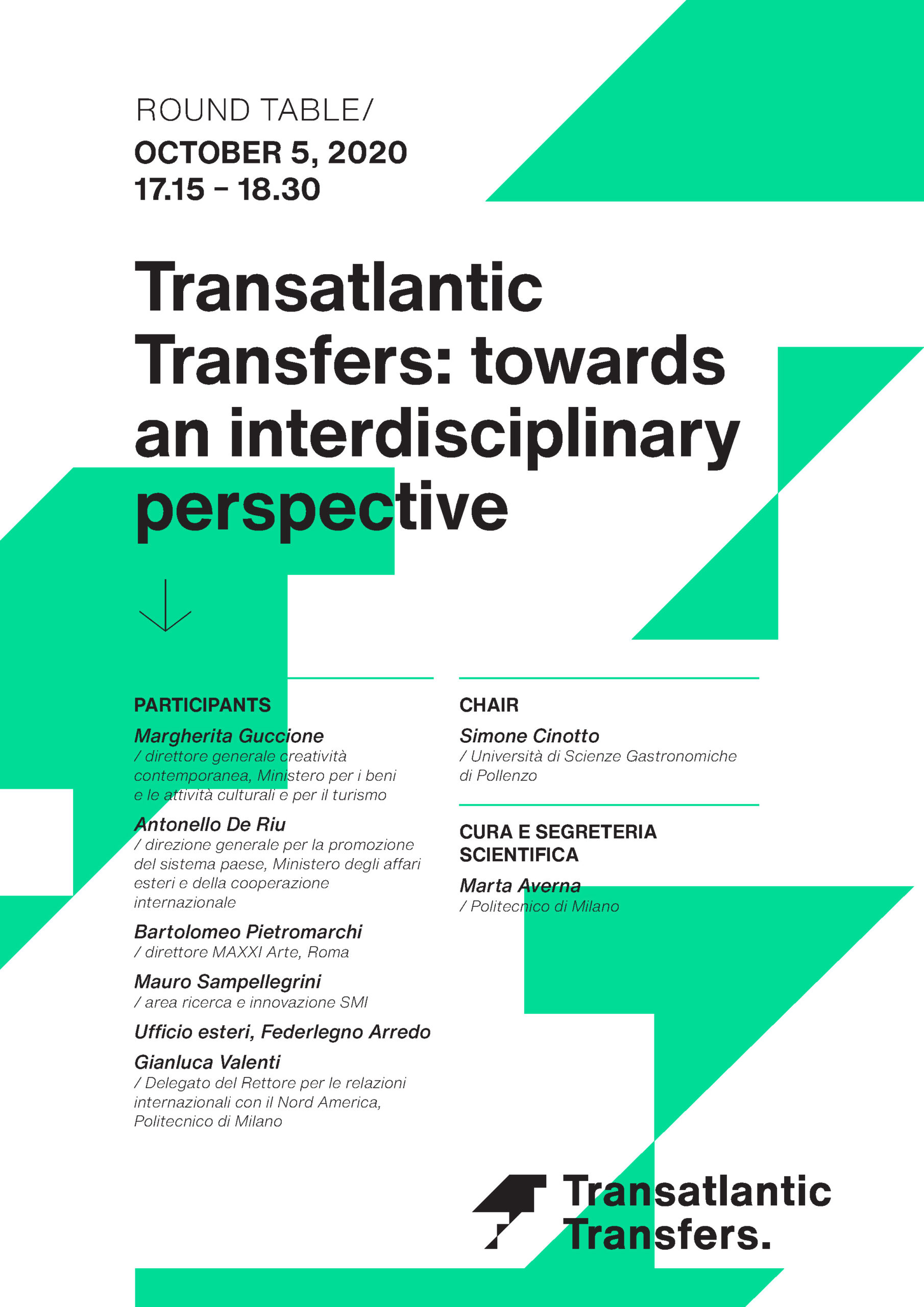
Lablog lecture @ LTH
September 13th, 2020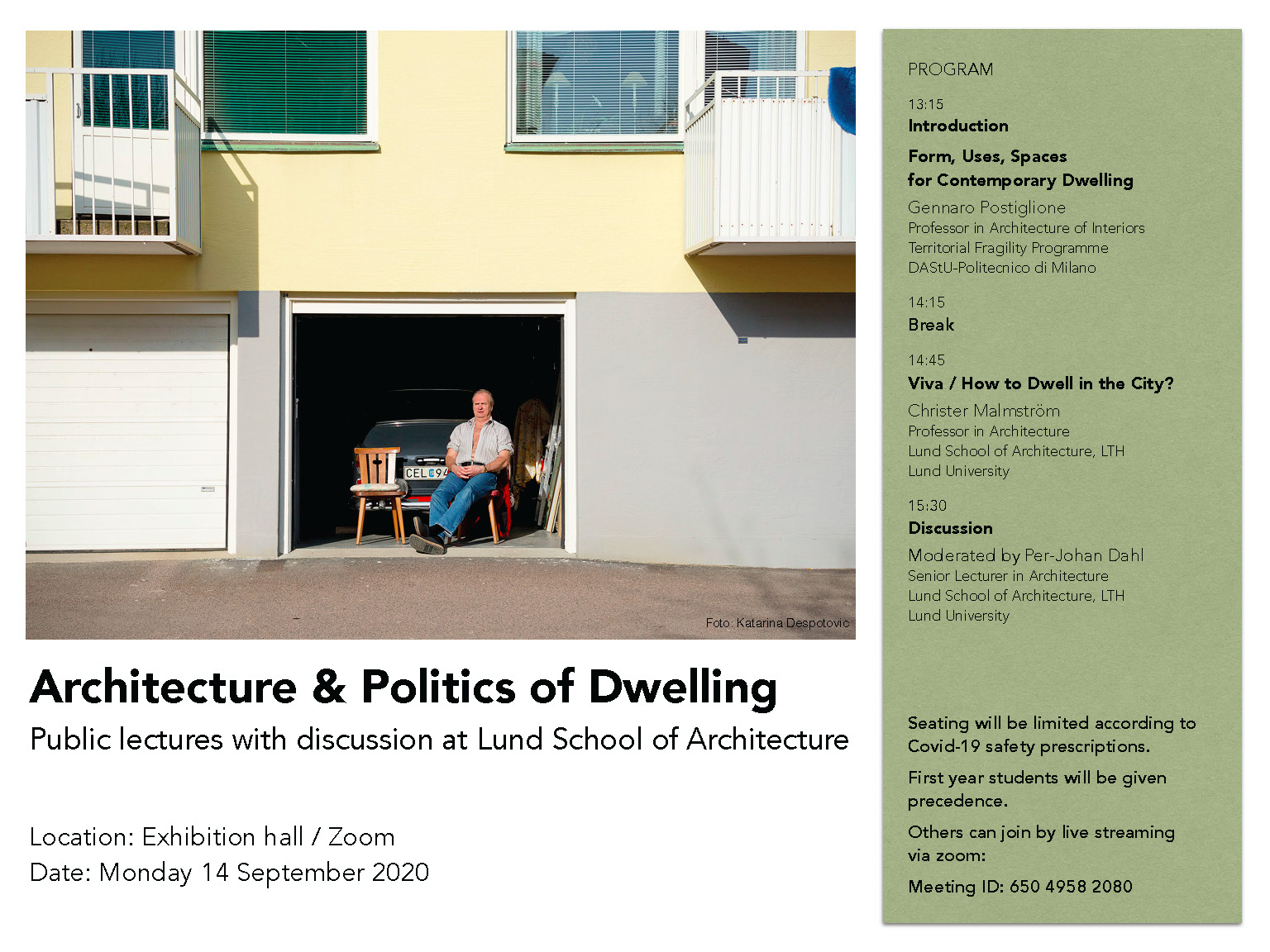
Architecture and the politics of dwelling
14 September
13:15-16:00
LTH – School of Architecture
Exhibition Hall
and
on LU Zoom
https://lu-se.zoom.us/j/65049582080
https://lu-se.zoom.us/u/cc1EMIus6i
13:15 Introduction by Emma Nilsson
Assistant Programme Director, School of Architecture, LTH Lund University
13:20 Visiting Professor Gennaro Postiglione
Form, Uses, Spaces for Contemporary Dwelling
14:45 Professor Christer Malmström
Viva / How to Dwell in the City?
15:30 Discussion
Moderator: Senior Lecturer Per-Johan Dahl
QHLab2020… a Biography
June 16th, 2020
An exploration of house-lives biographies in quarantined times, through the works of bachelor students from Politecnico di Milano, AUIC school.
March 2020: After a first wave in Asia, the spread of the Covid-19 in different countries of the world has lead many Governments to establish a series of lockdowns, asking people to stay at home in more or less restrictive ways. In some countries, the “quarantine” has lasted more than two months.
Follow the work on
The on-line Final Exhibition
The QHLab2020 Instagram profile
The QHLab2020 Pinterest account
Covid-19/an overview and some proposals
March 29th, 2020
A clear and sharp overview on Covid-19 health and socio-economic impacts with some significant proposals.
“Covid-19 is the largest health and economic crisis of our generation. We are all bombarded by a lot of news, which are evolving quickly, are often highly technical, and have policy consequences that dramatically affect our lives”.
“Andrea Galeotti and I [Paolo Surico] felt the need to learn some tools to process this information and to understand and rationalise current health and economic policies. We [They] created a narrative to highlight different trade-offs which are part of: a) every health policy that attempts to flatten the contagion curve of Covid-19, and b) every economic policy that attempts to flatten the ‘recession curve’ caused by Covid-19″.
You find their video presentations here!
Cornavirus allert to share
March 12th, 2020Dear all,
I have to share this report with you, and I will do within other networks too.
It is deadly urgent we all become aware about the actions we should all perform.
I forward a link to a scientific but descriptive report:
https://medium.com/@tomaspueyo/coronavirus-act-today-or-people-will-die-f4d3d9cd99ca
It is a long reading but if you are patient enough you can get a full sketch what we (Europe) are facing.
Do not underestimate the infection.
And I would also ask to share it within your own networks and media, please, since the relevance to be thoroughly informed is at the moment a key element in the battle.
Yours,
lablog
Semester start postponed to the 2nd of March
February 23rd, 2020.
POLIMI SEMESTER START
POSTPONED
TO 02 MARCH
Affordable Housing Studio / Final Exhibition + Thesis
January 28th, 2020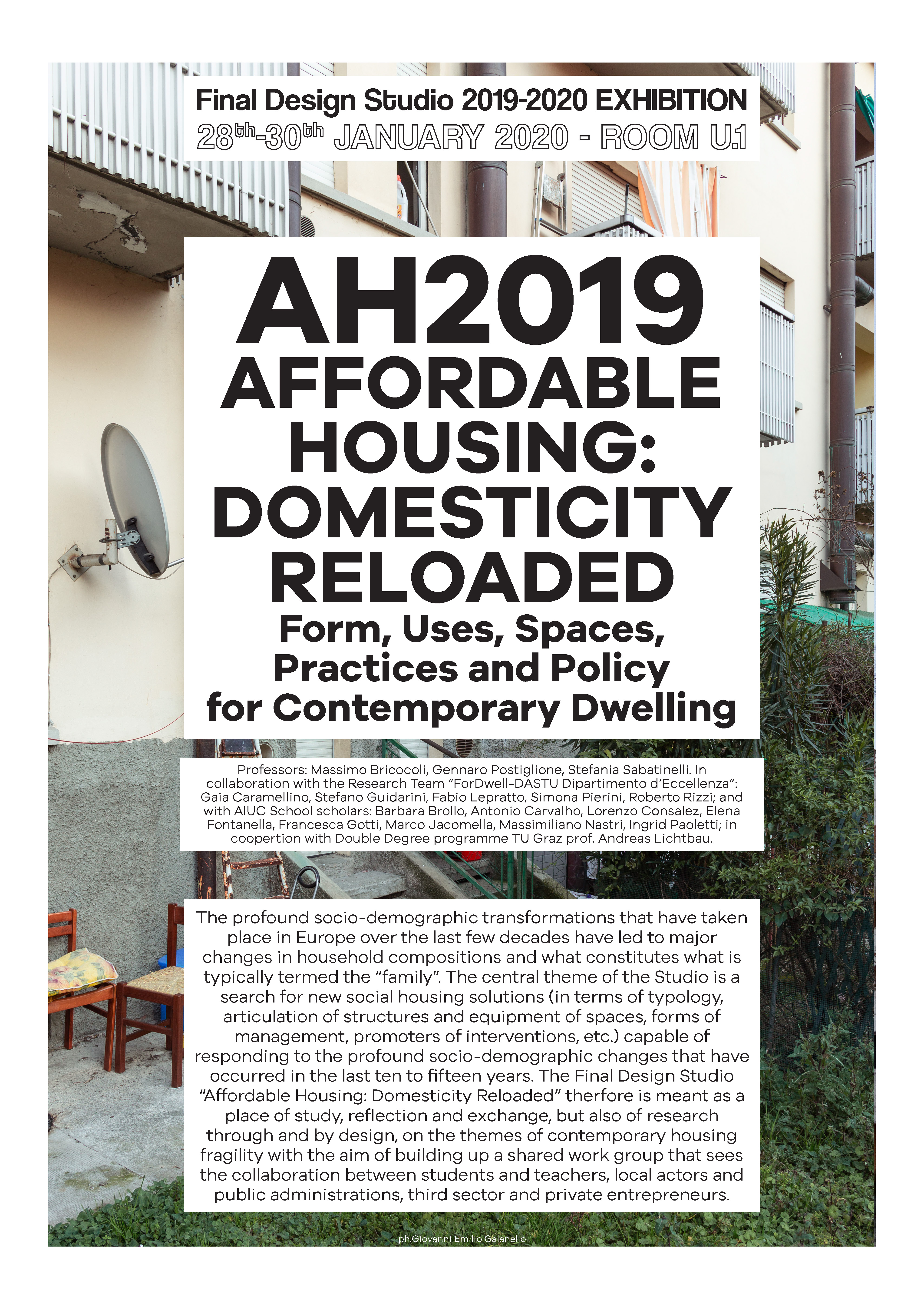
Professors
Massimo Bricocoli, Gennaro Postiglione, Stefania Sabatinelli. In collaboration with the Research Team “ForDwell-DASTU Dipartimento d’Eccellenza”: Gaia Caramellino, Stefano Guidarini, Fabio Lepratto, Simona Pierini, Roberto Rizzi; and with AIUC School scholars: Barbara Brollo, Antonio Carvalho, Lorenzo Consalez, Elena Fontanella, Francesca Gotti, Marco Jacomella, Massimiliano Nastri, Ingrid Paoletti; in coopertion with Double Degree programme TU Graz prof. Andreas Lichtbau.
Guest Crits
Sonia Calzoni, Calzoni architetti
Giuliana Costa, DAStU, Polimi
Marianna Taborelli, DAR=Casa
Mikel van Gelederen, Zeinstra van Gelderen architects
Francesco Falzetta, Casa Jannacci
Sibil Sträuli, Pini&Sträuli
Presented works [by theme]
Housing Affordability: the framework
Age-friendly housing
Housing and Commons
Productive Environments
Re-housing typology
FOLLOW UP WITH ALL DIPLOMA WORKS
Read the rest of this entry »
Affordable Housing Studio / Guest Lecture #04
November 23rd, 2019
Politecnico di Milano
Scuola di Architettura Urbanistica e Ingegneria delle costruzioni
Via Ampère 2 – Milano
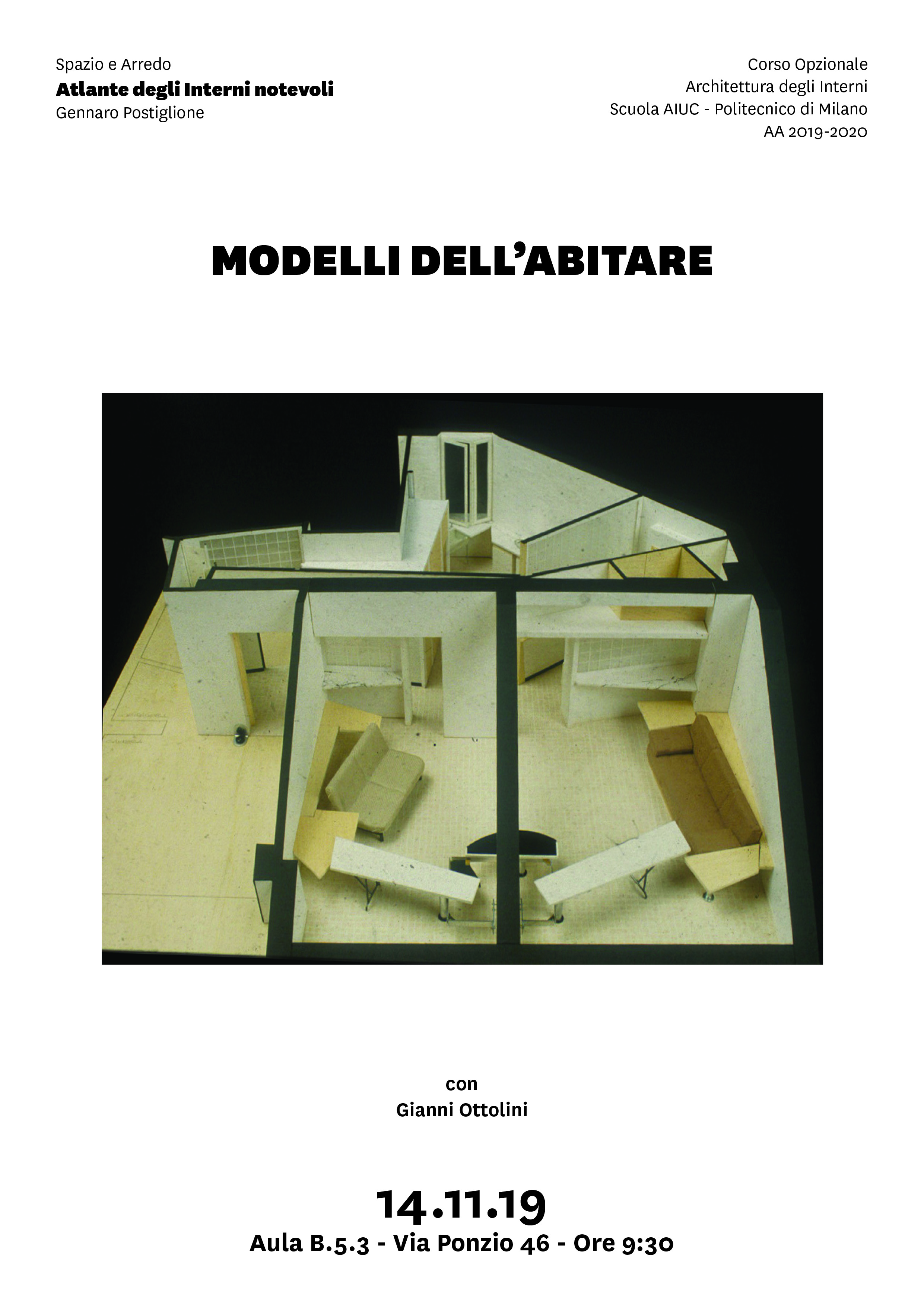

AMa2019 Housing Seminar #03
November 1st, 2019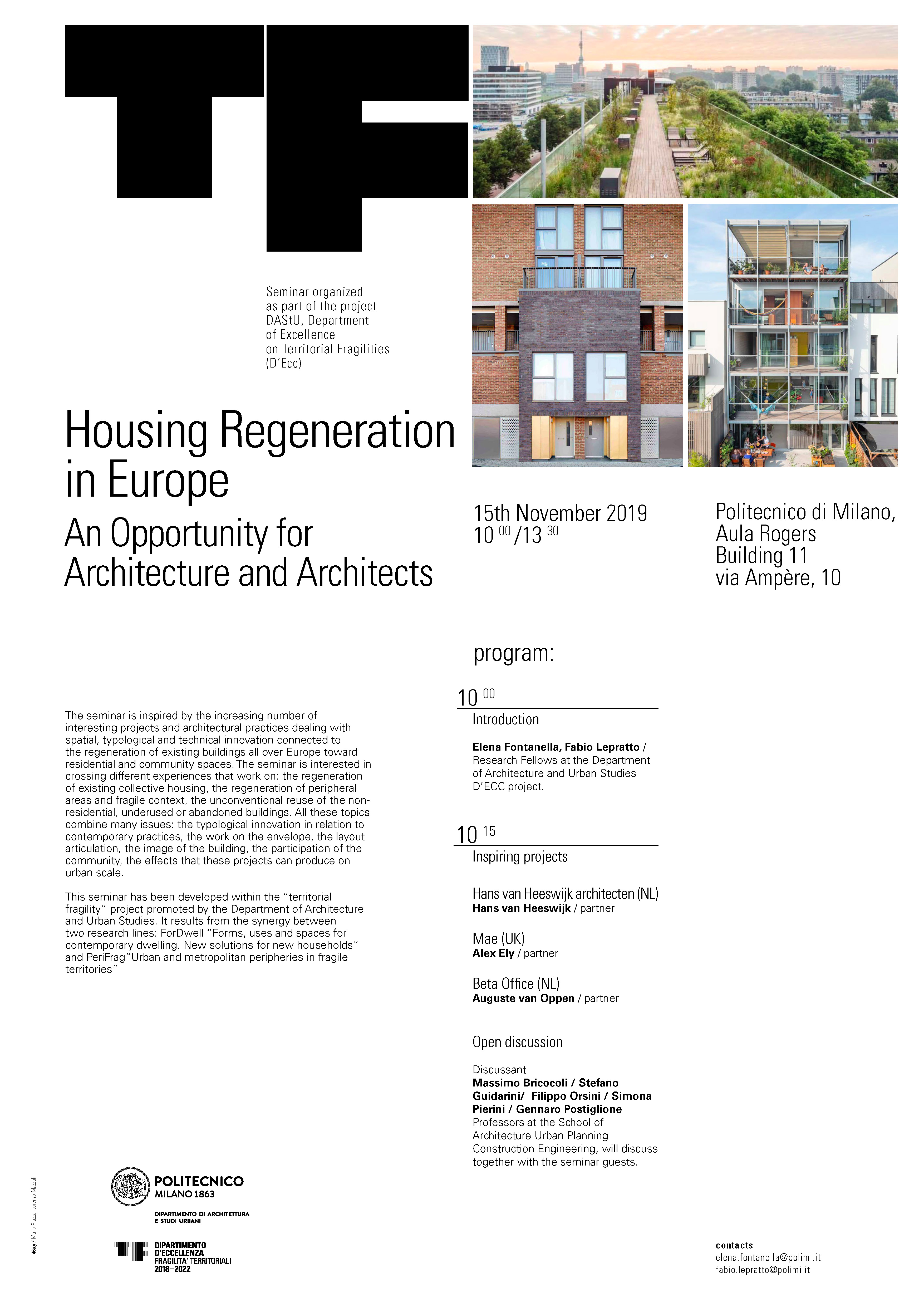
15th November 2019 / 10 00 – 13 30
Politecnico di MIlano
Aula Rogers, Via Ampère 2
Lectures by
Hans van Heeswijk architecten (NL)
Mae (UK)
Beta Office (NL)
The seminar is inspired by the increasing number of interesting projects and architectural practices dealing with spatial, typological and technical innovation connected to the regeneration of existing buildings all over Europe toward residential and community spaces. The seminar is interested in crossing different experiences that work on: the regeneration of existing collective housing, the regeneration of peripheral areas and fragile context, the unconventional reuse of the nonresidential, underused or abandoned buildings. All these topics combine many issues: the typological innovation in relation to contemporary practices, the work on the envelope, the layout articulation, the image of the building, the participation of the community, the effects that these projects can produce on urban scale.


